
Mogul vs. Monica
Mogul vs. Monica: Which Personal CRM Fits Your Life?
A source-checked comparison of Mogul and Monica across self-hosting, reminders, privacy, imports, exports, pricing, platforms, and maintenance.
 Chris Raroque
In this guide
The short answer: Choose Monica if open-source code, self-hosting, or a detailed record of friends and family is the point. Choose Mogul if you want a smaller hosted system for people, interactions, follow-up reminders, groups, and custom fields. Choose neither if you need automatic inbox enrichment, a shared sales pipeline, or a native Android app today.
The products assign responsibility differently.
Mogul asks you to maintain the relationship record. Monica can also ask you to maintain the server.
If you are still deciding whether you need software at all, begin with what a personal CRM actually does. If the category already makes sense, the rest of this comparison is about where you want the work—and the control—to live.
How this comparison was researched
We reviewed current public product, pricing, help, privacy, and official repository pages on August 21, 2026. We did not create competitor accounts, import a real address book, operate a Monica server, inspect private source code, or benchmark either product. Capabilities here are vendor-documented, not hands-on findings.
That boundary matters most for security, migrations, and roadmap claims. Optional encryption is not the same as an independent security audit. An available export button is not proof that every custom field will map cleanly into another app. A promised version is not a shipping version.
Which Monica is current? v3 is a roadmap; 4.x is stable
Before comparing features, untangle the name.
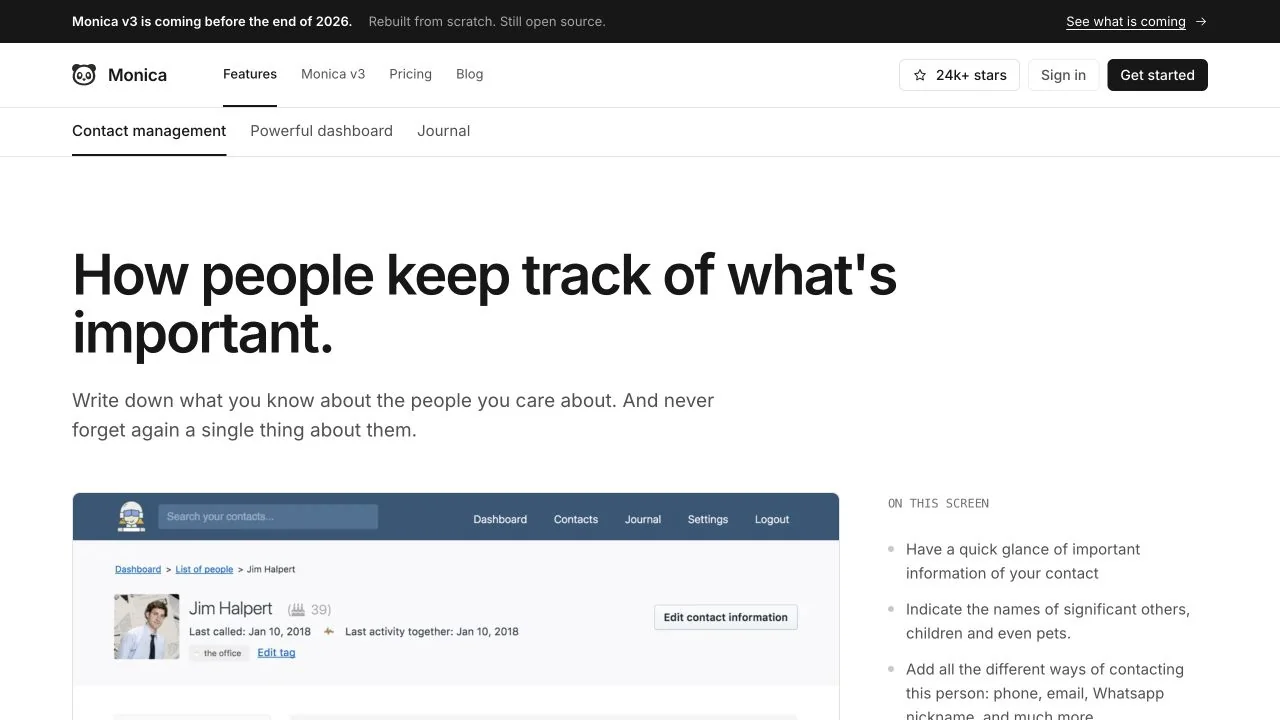
Monica’s current marketing site calls the upcoming rebuild Monica v3, labels it in development, and says it is expected before the end of 2026. Meanwhile, the official repository’s main branch calls itself a development beta and points readers to the 4.x branch as the stable and current version.
Those public labels do not line up neatly. This comparison therefore treats:
- the 4.x branch as the source for stable-version capabilities;
- the current hosted pricing and privacy pages as the source for today’s commercial service;
- v3 as a roadmap, not a feature you should buy today.
If you are about to self-host or migrate years of relationship history, confirm the exact build, import path, and upgrade path you will receive. “Monica” alone is not a precise enough version requirement right now.
Mogul vs. Monica at a glance
| Question | Mogul | Monica hosted | Monica self-hosted |
|---|---|---|---|
| What is the product shaped around? | People, interactions, search, groups, custom fields, and follow-up reminders | A broader personal relationship record with contacts, relationships, notes, activities, reminders, and journal-style context | The Monica application on infrastructure you control |
| Who runs the server? | Mogul | Monica | You or your hosting provider |
| Current price snapshot | Basic is free; Pro is $9.99/month or $99.99/year | $9/month or $90/year; 30-day trial stated | $0 software fee from Monica, plus hosting and administration |
| Reminders | Pro: one-time and recurring reminders with email and iOS notifications | Unlimited reminders listed in the hosted plan | Supported by the software; you configure reliable email delivery |
| Import | Help center documents CSV beta and iOS contact import | Current site says vCard and CSV | Import support depends on the exact version you deploy |
| Export | Help center documents separate CSV files for people, interactions, and reminders | Current pages promise account export; the privacy policy specifically names SQL | You control the database and the application’s exporters |
| Privacy model | Vendor-hosted; optional, vendor-documented end-to-end encryption on Pro | Vendor-hosted; no ads or data resale stated, but the privacy policy says contact data is not encrypted in the database | You choose the host, access controls, network, backups, and storage encryption |
| Open source | No public open-source claim found in the reviewed pages | Yes | Yes, with source access and modification rights under its license |
| Platforms confirmed in current copy | Web and iOS | Web access from phone, tablet, and desktop | Web, wherever you operate it |
| Native mobile direction | iOS available; Android is described as roadmap | v3 says a mobile-first web app, with native iOS and Android later | Same v3 direction, but you own deployment work |
| Ongoing maintenance | Product use and your data | Product use and your data | Updates, backups, monitoring, security patches, email delivery, and recovery testing |
Prices and features are snapshots from the linked vendor pages, before tax and regional differences. They can change.
Choose Monica when control is the feature
Monica’s clearest advantage is not a checkbox. It is the option to take responsibility for the whole system.
Monica’s pricing page says the self-hosted application is free from Monica. You provide updates, backups, monitoring, security patches, and infrastructure. Free software is not a free operating environment.
That trade makes sense when at least one of these is true:
- policy requires data to live on infrastructure you control;
- you want to inspect or modify the application code;
- you already operate reliable services and backups;
- leaving a vendor must not depend on that vendor remaining available;
- an API and self-hostable foundation matter more than a polished mobile workflow.
Self-hosting changes who holds the keys. It does not automatically produce secure operations. An unpatched public server with an untested backup is control in theory and risk in practice.
Monica also fits a fuller picture of personal life
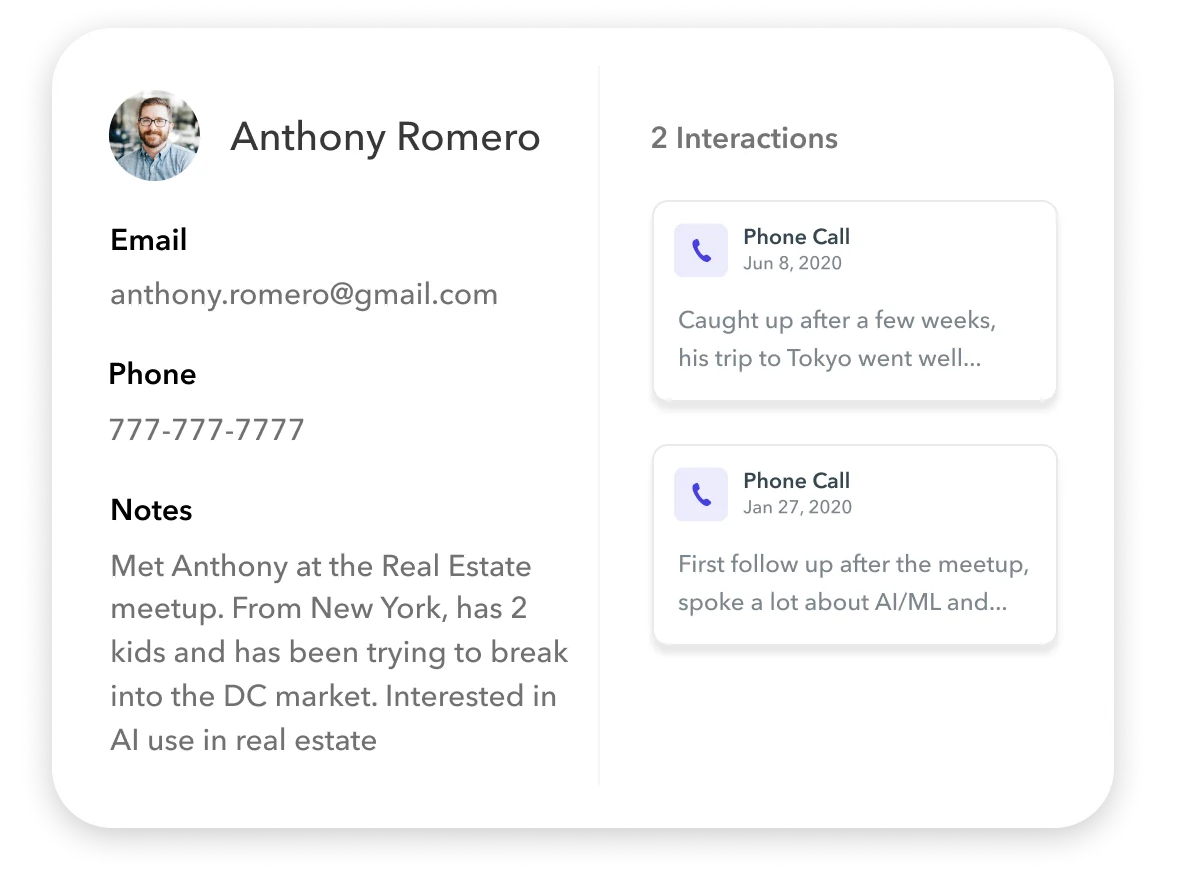
The stable 4.x feature list includes relationships between contacts, birthdays, activities, tasks, gifts, debts, pets, journal entries, documents, tags, custom activity types, and an API covering most data. That is a different center of gravity from a professional follow-up tool.
Choose Monica when “remember this person” includes family connections, gifts, shared activities, pets, or a journal of life—not only the last meeting and the next email.
This depth has a cost: more possible fields create more possible maintenance. A system can be comprehensive and still be too much for your habit.
Choose Mogul when focused follow-up is enough
Mogul’s product page centers on a focused loop: create a person, record interactions, search the record, organize people, and remember to follow up. Its current pricing page places unlimited people and interactions in Basic, then puts reminders, custom groups, custom fields, and optional end-to-end encryption in Pro.
That can be the better fit when:
- your network is mainly classmates, recruiters, investors, clients, mentors, or collaborators;
- a person, a running interaction history, and a next step cover most of the job;
- you want a hosted product rather than an infrastructure project;
- native iOS access and iOS reminder notifications matter;
- you want to begin with a hosted free plan before paying for reminder and organization features.
This is a fit argument, not a claim that Mogul is universally easier or faster. We did not time either workflow. The tighter scope is intentional.
Mogul documents optional end-to-end encryption—with limits
Mogul’s encryption guide says Pro users can opt in to end-to-end encryption using a separate encryption password. It also documents important trade-offs: losing the password can make encrypted data unrecoverable; push notifications become generic; decryption can add load time; and IDs, booleans, dates, and profile images were outside the encrypted scope described on that page.
The guide says it was last updated four years ago. Treat it as vendor documentation that needs current confirmation, not an audit report. Do not choose any relationship app on the word “encrypted” alone; ask what fields are covered, where keys live, how recovery works, and what metadata remains visible.
Monica’s hosted privacy policy makes a different disclosure: it says passwords are protected with bcrypt, two-factor authentication is available, but relationship data is not encrypted in the database and would be readable to someone who gained database access. Self-hosting lets you choose the infrastructure and storage controls, but it does not turn the application into an end-to-end-encrypted system by itself.
The honest privacy verdict is therefore conditional:
- choose Mogul Pro if current, field-level optional E2EE matches your threat model after you verify its scope;
- choose self-hosted Monica if infrastructure custody and inspectable code matter more;
- choose hosted Monica if its transparent policy and managed operation fit your needs, while accepting the database disclosure.
There is no meaningful “most private” label without naming the threat.
Hosted Monica is the middle path
You do not have to self-host Monica. Its current pricing page lists one hosted plan at $9 monthly or $90 yearly, with a 30-day trial and no credit card during the trial. The plan lists unlimited contacts, notes, reminders, activities, journal entries, relationships, custom fields, attachments, managed backups, automatic updates, and email support.
Hosted Monica is the sensible Monica choice when you want its open-source philosophy and broad personal-life model without becoming the on-call administrator.
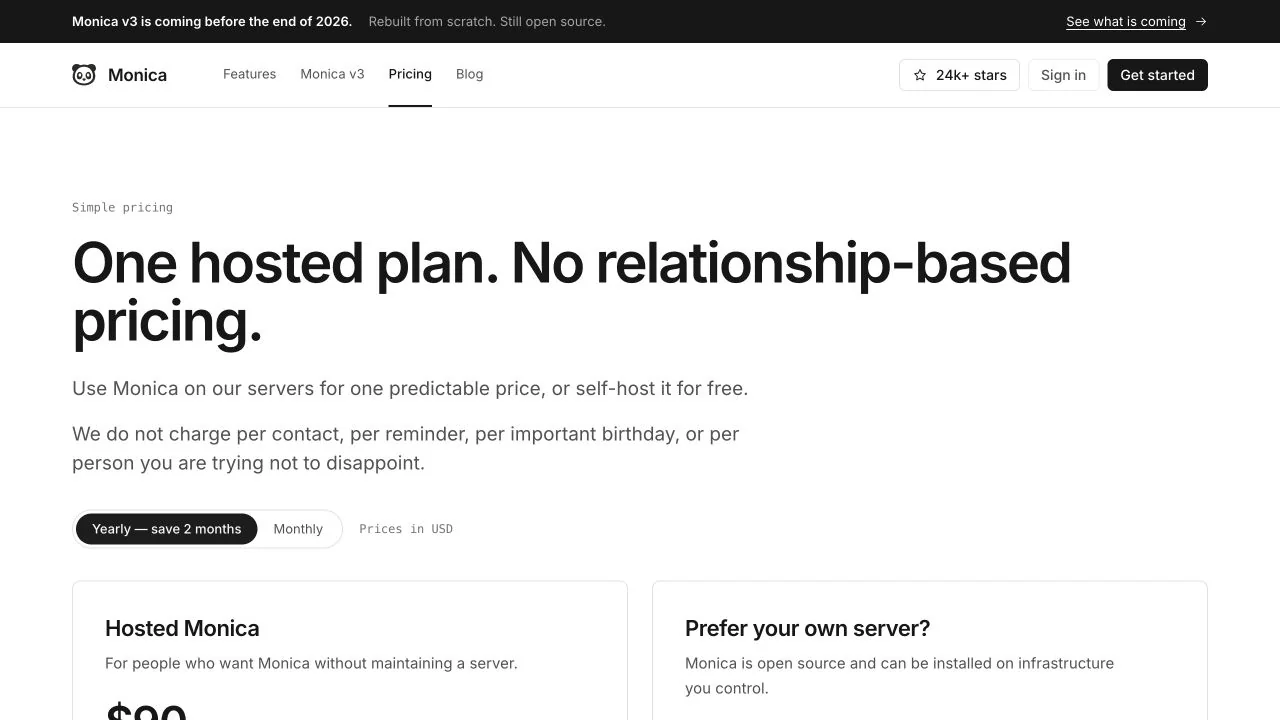
One pricing wrinkle is worth checking before you pay: Monica’s refreshed pricing page says “one hosted plan,” while its privacy page and stable 4.x repository text still contain references to downgrading or using a free hosted plan. Monica’s current pricing page is the best commercial source we found, but the checkout is the final answer.
Can you migrate between Mogul and Monica?
The migration question is not “Can I export?” It is “Can the next system understand the export?”
Moving from Monica to Mogul
Monica’s current pages promise export, and its privacy policy specifically describes a SQL export. Stable 4.x documentation also lists vCard export. Mogul’s getting-started guide documents a CSV importer in beta, while its export guide documents CSV files for people, interactions, and reminders. Both Mogul help pages report being last updated four years ago.
That is not a documented one-click migration. A Monica SQL or vCard export may need to be transformed into Mogul’s CSV shape, and Monica’s richer objects—gifts, debts, activities, relationships, pets, or journal entries—may not have direct destinations.
Moving from Mogul to Monica
Mogul’s documented CSV exports provide a promising starting point. Monica’s current homepage says it accepts vCard and CSV files. But field matching, custom interaction types, reminder recurrence, attachments, and relationship links still need a small test import before a full move.
Use ten representative contacts, not your entire address book. Include a person with custom fields, several interactions, a recurring reminder, a photo, and non-English characters. Export them, import them, then compare every field.
Portability is not a promise. It is a rehearsal.
Mogul vs. Monica pricing
Mogul’s current pricing lists Basic at $0, Pro at $9.99 monthly, and Pro at $99.99 yearly. Basic includes unlimited people and interactions. Pro adds the organization, reminder, and encryption features most people will compare. The same page lists a $49.99 yearly education price for eligible students and teachers.
Monica’s current pricing lists hosted service at $9 monthly or $90 yearly. Self-hosted software costs $0 from Monica, but the page correctly assigns server cost, updates, backups, monitoring, security work, and email delivery to you.
Hosted Monica ($90/year) is $9.99 cheaper than Mogul Pro ($99.99/year)—a difference too small to decide the purchase. What differs is the work each product includes. A lower subscription loses quickly if it creates a workflow you abandon; “free” self-hosting becomes expensive quickly if recovery fails.
Which platforms do Mogul and Monica support?
Mogul’s pricing FAQ identifies the web and iOS app as supported and says native Android and Mac apps are on the roadmap. The same page footer links desktop downloads, including Mac, Windows, and Linux beta, so verify which desktop builds are currently supported before making them a requirement.
Monica is a web application. Its hosted plan says it is accessible from phone, tablet, and desktop. The v3 roadmap promises a responsive web application first, with native iOS and Android applications to follow.
If native Android is non-negotiable today, neither public roadmap is enough. Choose a product that ships the platform you need now, not one whose roadmap agrees with you.
Choose neither when the real problem is different
Mogul and Monica both expect you to make a relationship record. Neither reviewed product page promises the full automatic capture model of a system that continuously reads your inbox, calendar, LinkedIn network, or messaging history.
Choose another category when you need:
- automatic email, calendar, or LinkedIn enrichment with minimal manual entry;
- a shared sales pipeline, deal stages, forecasting, campaigns, or account ownership;
- team permissions and operational reporting;
- a confirmed native Android workflow today;
- regulated-data controls that your security or legal team must validate;
- no additional habit at all.
A contacts app plus a weekly calendar reminder may be enough. Our personal CRM shortlist covers other workflow shapes, and we have applied the same evidence standard to Mogul vs. Dex and Mogul vs. Mesh. The alternatives hub holds every comparison.
Verdicts by user type
| You are… | Start with… | Why |
|---|---|---|
| A self-hoster with reliable backups | Monica self-hosted | Infrastructure control and inspectable source are the point |
| A nontechnical person who wants Monica’s whole-life model | Monica hosted | The broader relationship record without server operations |
| A student or job seeker tracking conversations and follow-ups | Mogul Basic, then Pro if reminders earn their keep | The focused people-and-interactions model fits the job; eligible education pricing is documented |
| A founder, investor, consultant, or freelancer who records notes deliberately | Mogul | People, interaction history, search, groups, custom fields, and reminders map directly to the workflow |
| Someone who wants family, gifts, pets, activities, and a journal in one system | Monica | Stable Monica documents those deeper personal-life objects |
| Someone who requires optional E2EE in a hosted personal CRM | Mogul Pro, after verifying current scope | Mogul’s help center documents the option and its exclusions; Monica’s hosted policy says relationship data is not encrypted in the database |
| An Android-first user who requires a native app | Neither, until current availability is confirmed | Both reviewed sources describe Android as future rather than shipping |
| A sales or partnerships team | Neither by default | A shared team CRM is usually the correct architecture |
A ten-question decision checklist
- Do I want to run a server, or merely use an app?
- Is my record mainly professional interactions, or the wider texture of personal life?
- Will I actually write notes after conversations?
- Do I need reminders, and must they recur?
- Which devices must work today?
- Is infrastructure custody or end-to-end encryption the more relevant privacy requirement?
- What happens if I lose an encryption password?
- Which fields must survive an export and re-import?
- Am I prepared to test backups and restore them?
- Can I run the workflow with ten contacts for two weeks before importing everyone?
Choose the answer that removes a real failure mode, not the one with the longest feature list.
Frequently asked questions
Is Mogul a good Monica alternative?
Mogul is a credible Monica alternative when your priority is a hosted, deliberate workflow for people, interactions, search, reminders, groups, and custom fields. It is not a drop-in replacement for Monica’s self-hosting, open-source code, API, journal, or broader personal-life objects.
Is Monica free?
Monica’s software is free to self-host, but you pay for infrastructure and do the maintenance. Its current pricing page lists the hosted service at $9 per month or $90 per year with a 30-day trial. Older public Monica text still references a free hosted plan, so confirm the current checkout rather than relying on an old screenshot.
Does Monica have end-to-end encryption?
We found no current first-party Monica page claiming end-to-end encryption for the hosted relationship database. Monica’s privacy policy instead says the data is not encrypted in the database. Self-hosting gives you infrastructure control and lets you add storage and network protections, but that is not the same security property as application-level E2EE.
Which is more private, Mogul or Monica?
It depends on the threat. Mogul’s four-year-old help article documents optional E2EE with exclusions and recovery trade-offs. Monica can be self-hosted on infrastructure you control and its source can be inspected, while its hosted privacy policy says relationship data is not encrypted in the database. Verify current implementation details before storing sensitive information.
Can I move from Monica to Mogul?
Probably with data preparation, but no direct migration path is documented. Monica offers exports, while Mogul’s older help page documents CSV import in beta. Expect to map fields and leave some Monica-specific objects behind.
Can I move from Mogul to Monica?
Mogul’s older help page documents CSV exports for people, interactions, and reminders; Monica says it accepts CSV and vCard imports. That makes migration plausible, not guaranteed.
Which one has a mobile app?
Mogul has a documented iOS app and web access. Monica is web-based; its v3 page says the web application will be designed for phones first and native iOS and Android apps will follow. If a native Android app is required, verify another option that ships one today.
Which is better for students?
Mogul is the more direct fit for internship, recruiting, alumni, and mentor follow-up, especially if a simple interaction log is enough. Monica may fit a student who values open source, self-hosting, or a whole-life relationship journal. Mogul’s pricing page currently documents a $49.99 yearly education plan for eligible students and teachers.
Which is better for teams?
Neither is the default answer for a team sales process. Neither product’s reviewed pages document the shared ownership, stages, campaigns, audit trails, and reporting a sales team typically needs. Compare team CRMs instead.
Your decision is ready when you know who maintains the server, what survives an export, and which required platform ships today.